

What the DIN 13164 standard is
DIN 13164 is the German standard that defines the minimum first aid contents for a motor vehicle. It is published by the Deutsches Institut fur Normung (DIN), the German national standards body, and its full title is "Erste-Hilfe-Material, Verbandkasten fur Kraftfahrzeuge" (first aid material, first aid kit for motor vehicles).
The standard does one job precisely. It lists exactly which items a vehicle first aid kit must contain, in what quantities, and to what quality and packaging level. Nothing about the standard is a suggestion. A kit is either complete to the specification or it is not compliant.
The current version is DIN 13164:2022, which replaced the long-running DIN 13164:2014 edition. The most visible change in the update was the addition of two face masks to the required contents, reflecting lessons from the pandemic period. If you are reading an older kit label or an older supplier datasheet, check the year, because a 2014-spec kit no longer matches the current standard.
The DIN 13164 specification: exact contents
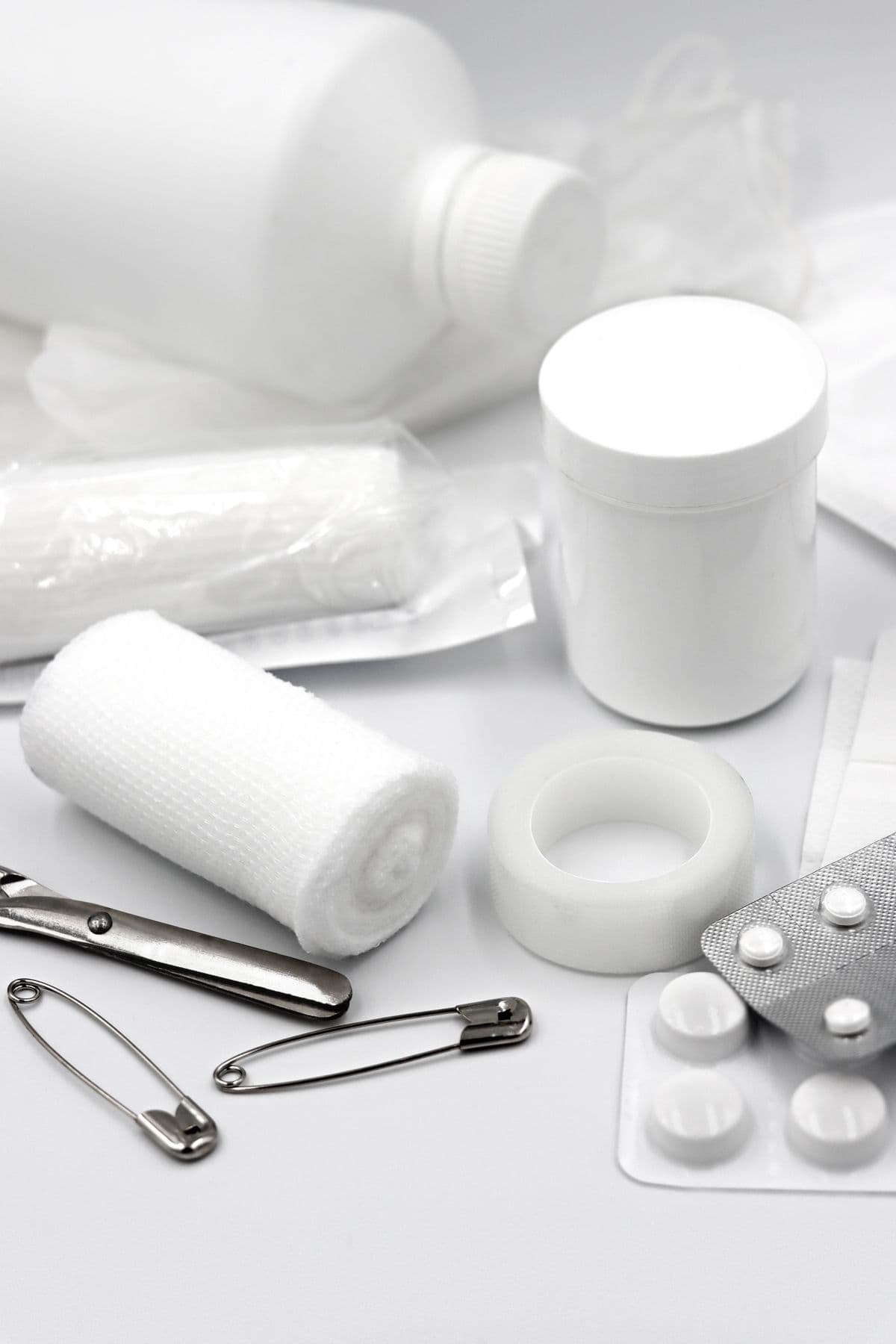
The value of a written standard is that everyone works from the same list. A DIN 13164:2022 compliant kit contains the following items and quantities:
| Item | Quantity |
|---|---|
| Adhesive plaster (5 m x 8 cm) | 1 |
| Wound dressing plasters, assorted | 8 |
| Sterile wound dressing (small, medium, large) | 1 each |
| Gauze bandage (6 cm and 8 cm) | 2 and 3 |
| Sterile compress | 6 |
| Triangular bandage (cloth) | 2 |
| Rescue / emergency blanket | 1 |
| Fleece / dressing pack | 5 |
| First aid scissors | 1 |
| Disposable gloves (pairs) | 4 |
| Face mask | 2 |
| Skin cleansing wipes | 4 |
| First aid instruction leaflet | 1 |
Quantities and exact item descriptions can vary slightly between certified suppliers as the standard is periodically revised, so always confirm the kit is labelled to DIN 13164:2022 rather than an earlier edition. The point of the specification is that a driver, an inspector and an insurer all know what "compliant" means without opening a negotiation.
Two rules sit alongside the contents list and matter just as much:
- Expiry. Sterile dressings, compresses and cleansing wipes lose effectiveness over time. Every DIN 13164 kit carries an expiry date, and an expired kit is non-compliant even if every item is physically present.
- Completeness. After any use, even a single plaster, the kit must be restocked to its full specification. An incomplete kit is a non-compliant kit.
Is DIN 13164 a European specification?
This is one of the most common questions, and the honest answer has two parts.
DIN 13164 is a German national standard, not a formal pan-European (EN) norm. There is no single "EU first aid kit law" that every member state has adopted by the same number. Each country writes its own road-traffic rules.
In practice, however, DIN 13164 has become the de facto European specification for vehicle first aid. It is the most widely recognised vehicle kit standard on the continent, and inspectors and insurers across Germany, the Netherlands, Belgium, Luxembourg, Austria and beyond accept it as proof of adequate provision. For a fleet crossing borders, a DIN 13164 kit is the single most practical way to satisfy multiple national requirements at once. One standard, several countries covered.
So when someone searches for a "DIN 13164 European specification," what they usually need is exactly this: confirmation that a German standard functions as the common European benchmark, even though it is not labelled as an EN norm. Some countries do specify their own numbers (Austria uses ONORM V 5101, for example), but a DIN 13164 kit is generally recognised alongside them.
For a full country-by-country breakdown, see our guide to vehicle first aid kit requirements by country.
DIN 13164 next to the other German standards
DIN 13164 is often confused with the two German workplace kit standards because the numbers look similar:
- DIN 13164 is the motor vehicle kit.
- DIN 13157 is the small workplace kit.
- DIN 13169 is the large workplace kit, essentially two DIN 13157 kits combined.
The distinction matters for fleets. In Germany a light commercial vehicle used for work is often treated as a mobile workplace, which can mean a van needs a DIN 13164 kit for road-traffic compliance and DIN 13157 provision for the people working out of it. We cover this in detail in our complete German first aid standards guide.
Sourcing note: "China DIN 13164 standard" kits

A large share of the world's first aid supplies is manufactured in China, and many kits are marketed there and online as "DIN 13164 standard." That is not automatically a problem. DIN 13164 is a published specification that any manufacturer anywhere can build to, and plenty of imported kits genuinely meet it.
The risk is not the country of origin. It is the gap between a label that says "DIN 13164" and a kit that has actually been tested and certified to the current 2022 edition. When you source imported kits, a few checks separate a compliant product from a lookalike:
- Which edition? Confirm the kit is built to DIN 13164:2022, not the withdrawn 2014 version. A common shortcut is to ship the older, cheaper spec under the DIN 13164 name.
- Certification, not just a claim. Ask for the conformity documentation, not only a line on the packaging.
- Real expiry dates. Sterile components must carry genuine, in-date expiry markings, not a distant blanket date printed on the outer box.
- Complete contents. Count the items against the specification above. Missing compresses, gloves or masks are the most common shortfall in bargain kits.
Buying to a written standard is exactly what protects you here. Because DIN 13164 defines the contents precisely, you can verify any kit, from any supplier, against the same objective list.
Keeping DIN 13164 kits compliant in a fleet
Choosing a certified kit is the start, not the finish. Compliance is lost over time, not at the point of purchase, and the failures are predictable:
- Kits buried under tools or cargo, so a driver cannot reach them in seconds.
- Expired sterile contents that nobody inspected.
- A kit used once and never restocked, left incomplete for months.
- Generic household kits that never met the specification in the first place.
The fix is systematic rather than complicated. Mount each kit in a fixed, visible position inside the vehicle. Run a short monthly inspection to catch expired or missing items early. Replace used or expired components immediately, and keep spare refills at the depot so a swap takes seconds.
The HYSAVER unit integrates a DIN 13164 first aid kit in a fixed, visible position inside the vehicle, pre-stocked and compliant out of the box, with tool-free replacement. HYSAVER can also supply kits certified to DIN 13157, DIN 13169 and the UK BS 8599 standards, so a mixed fleet and premises can be covered from one supplier.
Kits and replacement components are available at store.hysaver.com. Contact us to confirm which standard applies to your vehicles and sites.
Questions or interested in HYSAVER? Get in touch.